
Project vs. Product Managers - Why is there always conflict?
If you’ve ever watched ‘The Fresh Prince of Bel-Air’ you probably remember the iconic scene above. Will Smith’s estranged father comes back into Will’s life trying to make amends for being absent in their relationship only for Will’s father to disappear on him again. Dejected, Will ponders to his Uncle Phil, ‘How come he don’t want me, man’?
Your first thoughts are probably what does this have to do with project vs. product management. Well, from first hand experience I’ve felt the same way as Will did in past projects I’ve worked on. As a project manager, I was really excited to work with a team to build something great only to feel like the product manager and product team was more invested in everything else BUT how we could collaborate and work together.
When project and product management work lock in step, it is a beautiful experience of defining the ‘what and how’ (product) with the ‘what and when’ (project) to create full transparency on what is delivered to the customer.
Without this collaboration, the project tends to suffer from a lack of transparency and accountability creating project delays and unhappy stakeholders with little to no visibility on project progress.
So how do product and project managers coalesce to successfully release a product on time and within budget? I will get to that in a moment but first let’s talk about the roles of product and project managers.
What is a Product Manager?
A product manager owns the product strategy by helping define what brings value in the end, specifying functional requirements and articulating what success looks like both internally and externally for the product.
What is a Project Manager?
A project manager is responsible for the planning, monitoring and execution of a project by helping to push for a concrete scope with a defined start and finish.
What creates conflict between both parties?
This is where things can get complicated. For product and project managers there are definite overlaps in responsibility and if boundaries are not established this can create tension.
Take a look at the chart below (bear in mind this is not the scenario 100% of the time and varies depending on the company, business structure and industry):
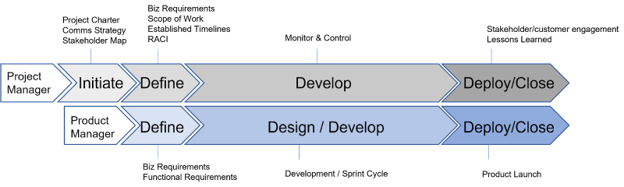
The top row details the role of the project manager while the bottom row details the role of the product manager across a product lifecycle.
Initiate
The project manager’s work starts in the ‘Initiate’ phase. Here, the project manager is responsible for setting the scene for the project; developing a project charter, establishing the communication strategy and setting expectations from the stakeholders on the ‘what’ of the project.
Define
In the ‘Define’ phase, the project manager and product manager share responsibility in further establishing (and agreeing upon) the business requirements for the product work. Business requirements detail the business solution for a project including the customer’s needs and expectations.
The product manager owns the functional requirements of the product. Functional requirements are the features and functions the development team will implement to ensure product delivery. Together, with business requirements and functional requirements a scope of work is established to clearly define the product team’s responsibilities.
With agreement and sign-off between the product team, project manager and stakeholders across the documents mentioned above, the project manager (working with the product manager) should own the development of a timeline to further define project delivery. Agreement on success criteria and KPIs (key performance indicators) for the project should also be established. And lastly, to avoid confusion on responsibilities, a RACI document outlining roles and responsibilities of the team should be easily accessible across all parties to help with visibility across the project.
Develop
The ‘Develop’ phase is where the actual product development work happens. The product manager/product team maintains the majority of responsibility here through designing, developing and testing the solution.
It is of key importance to create a transparent layer of constant conversation between the project and product manager to report progress back to the project stakeholders and to identify any risks that may cause the project to slip.
Deploy/Close
In the final phase, the product is deployed to the customer from the product team. There is a post-mortem meeting led by the project manager to ‘close out’ the project. The project manager maintains a lessons-learned document reflecting positive and negative elements of the project's journey that can be used as reference for future projects.

So what is the best way to address conflict between Product and Project Managers?
Find some common ground.
I cannot stress enough how important it is for a product development project to have both a product and project manager. Both disciplines are critical in helping push the project forward through problem solving and team coaching. Where projects have found the most success lies in understanding the value of what both disciplines bring to the table.
For your next project that involves a product manager or vice versa, set up an initial kick-off call strictly between the project and product managers. Talk through each other’s expected outcomes, what is deemed 'project success', and what each individual’s responsibilities will be across the product life cycle. Talk through and come to agreement on what is considered project overlap. By hashing out these topics from the onset, the rate of success will greatly increase and you can look to build great projects together.